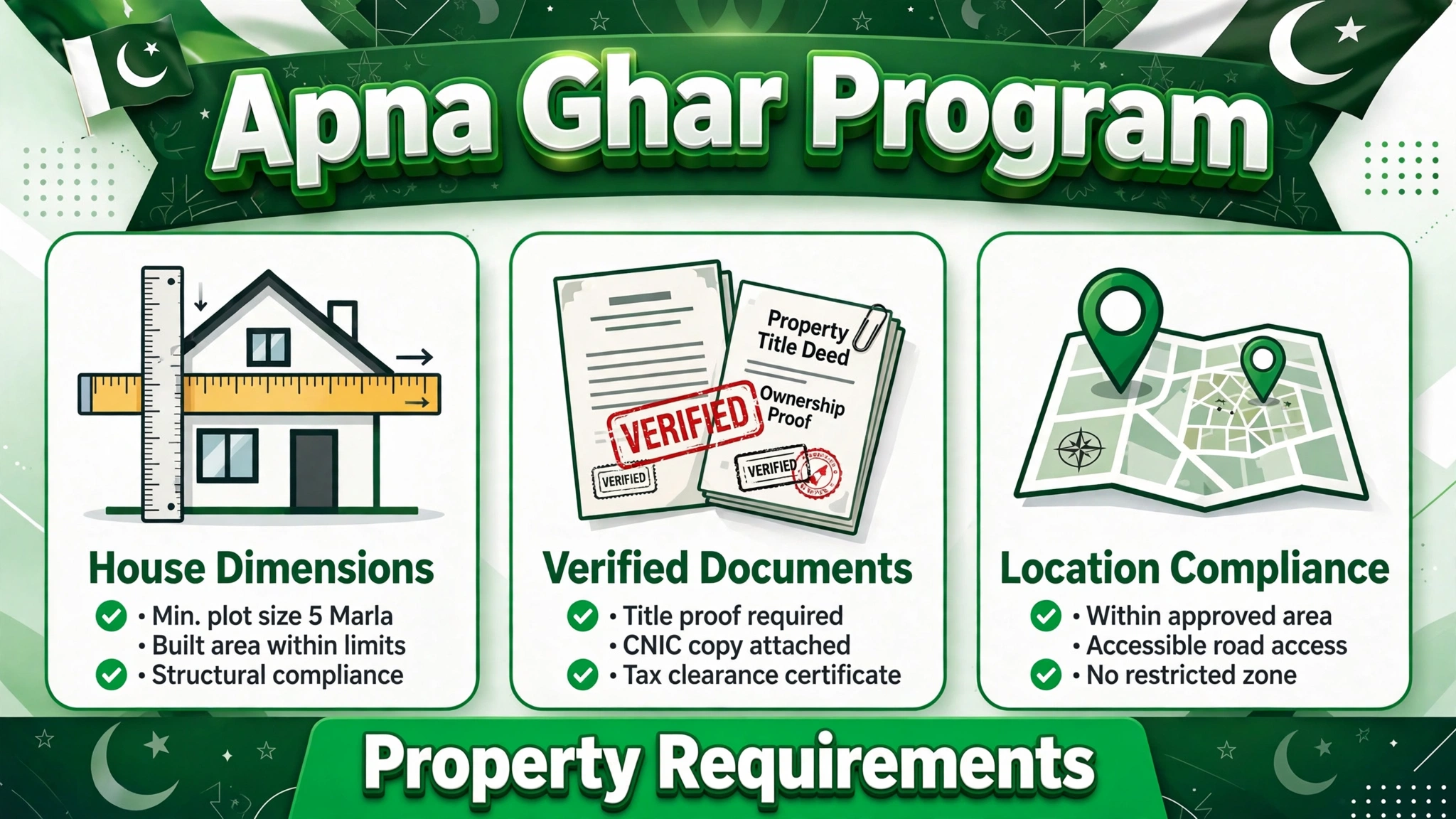
Before you fall in love with a property, make sure the program will finance it. The Apna Ghar Program property requirements decide which houses, plots, and flats qualify for financing — and applying for an ineligible property wastes weeks of your time. In this guide, we explain the eligible property types, size and value limits, location rules, required property documents, which properties are excluded, and answers to frequently asked questions.
Why Property Requirements Matter
The Wazir-e-Azam Apna Ghar Program 2026 is designed for affordable, owner-occupied housing — not luxury villas or commercial investments. Every property goes through property verification before disbursement, so understanding the rules upfront saves you from a rejected application. Check the applicant-side rules in our eligibility guide too.
Eligible Property Types
Ready House Purchase
Buying a completed, ready-to-move house — the most common use of the program. See our house purchase guide.
Plot Construction
Building a new house on a plot you already own, with financing released in construction stages. See our plot construction guide.
Flat / Apartment Purchase
Buying a flat in an approved residential project is also covered. See our buying a flat guide.
Home Renovation / Extension
Financing is available for major renovation or adding a floor to your existing house.
Property Size and Value Limits
| Requirement | Typical Limit |
|---|---|
| Maximum house size (urban) | Up to 5 marla plot / 1,350 sq ft covered area |
| Maximum house size (rural) | Up to 10 marla plot |
| Maximum property value | Up to Rs. 10 million (varies by bank tier) |
| Maximum financing | Up to 90% of the property value |
| Owner occupation | The property must be for your own residence, not rental investment |
Limits can vary slightly between banks — confirm with your chosen bank from the banks list.
Location Requirements
- Residential area: the property must be in a recognized residential area — agricultural or purely commercial land is not eligible.
- Approved societies preferred: properties in approved housing societies clear verification fastest.
- Clear access: the property should have proper road access and be identifiable on revenue records.
- No restricted zones: properties in government-restricted or disputed zones cannot be financed.
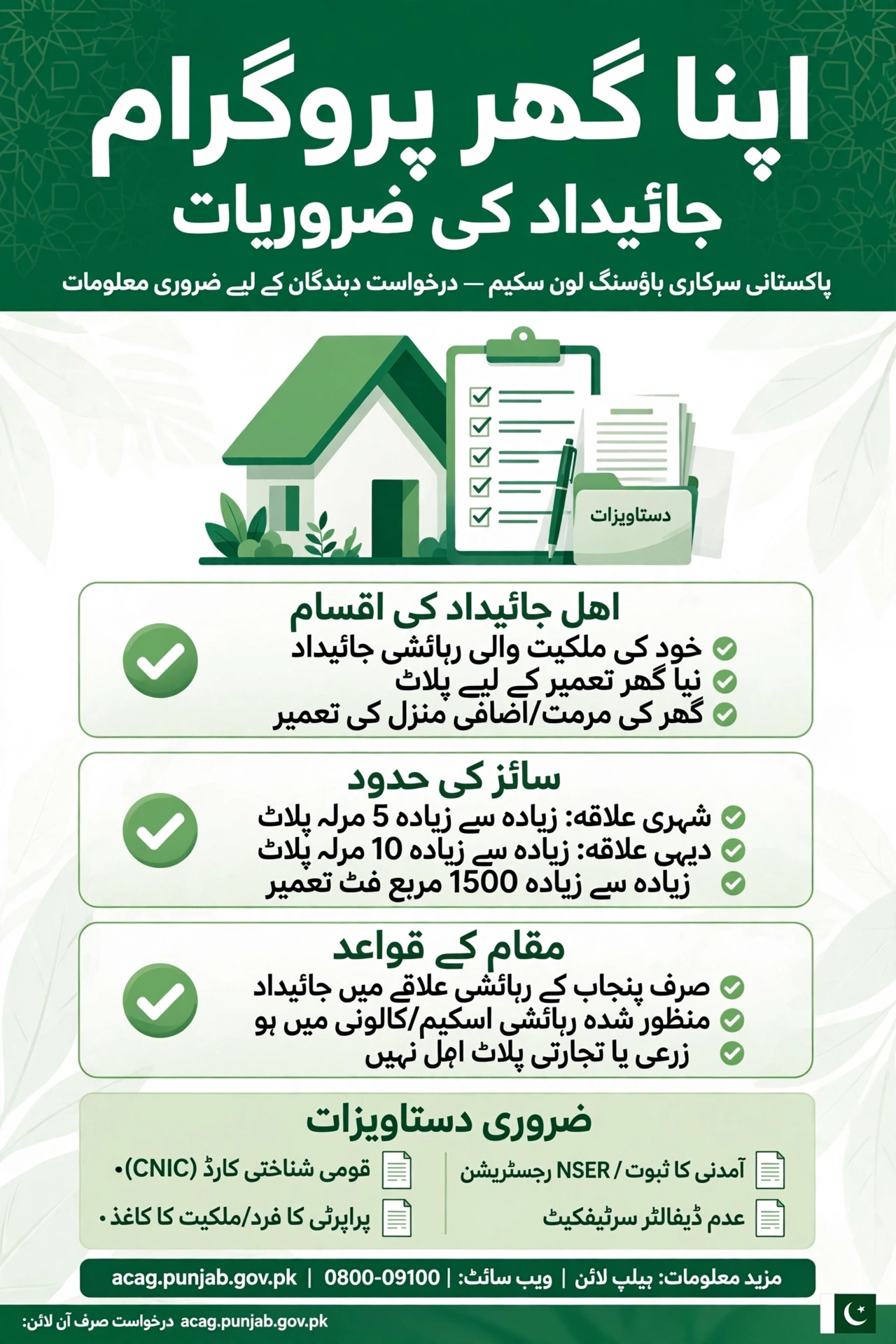
Property Documents You Must Have
- Registry / sale deed and fard-e-malkiat proving ownership
- Mutation (intiqal) records showing the ownership chain
- Approved building plan for constructed properties
- Seller’s CNIC copy
- Society NOC / allotment letter for society properties
- Property tax receipts paid up to date
Properties That Are NOT Eligible
- Properties with disputed titles or ongoing court cases
- Agricultural land not approved for residential use
- Commercial-only properties (shops, plazas without residential portion)
- Properties already mortgaged to another bank
- Under-construction projects without approved plans
- Properties valued far above the program’s financing ceiling
FAQs – Apna Ghar Program Property Requirements
Can I buy a house in any city?
Yes, as long as it’s a residential property meeting the size, value, and documentation requirements — location rules are about the property’s legal status, not the city.
Is there a minimum property size?
No strict minimum, but the property must be a genuine residential unit — banks won’t finance token or unusable parcels.
Can I finance a plot without immediate construction?
Generally no — plot financing is tied to construction. Check the plot construction guide for how staged disbursement works.
Can I buy a property from a family member?
Usually allowed if the transaction is genuine, at fair market value, and fully documented — but expect extra scrutiny.
Are flats in high-rise buildings eligible?
Yes, if the project is approved and the flat has clear title documentation.
What if the property value exceeds Rs. 10 million?
The bank will only finance up to its approved limit; you’d need to arrange the difference yourself.
Can I renovate instead of buying?
Yes — renovation and home-extension financing is part of the program for existing homeowners.
Final Thoughts
Knowing the Apna Ghar Program property requirements before you start house-hunting keeps your application on solid ground: the right type, the right size, a clean title, and complete documents. Match your property to these rules first — then let the bank’s verification confirm what you already know.