If you already own a residential plot but do not have enough savings to build on it, Apna Ghar Program plot construction financing is made for you. Under the Wazir-e-Azam Apna Ghar Program 2026, eligible Pakistanis can get subsidized financing to construct a house on a plot they already own — with a fixed 5% markup for the first 10 years and repayment spread over up to 20 years. In this complete guide, we explain the eligibility criteria, plot requirements, loan amount, required documents, step-by-step application process, construction stages, and answers to the most common questions.
What Is Apna Ghar Program Plot Construction?
Plot construction is one of the three financing purposes covered under the Apna Ghar Program, alongside buying a ready-built house and buying a plot plus construction. Instead of purchasing a new property, the bank finances the cost of construction on a residential plot that is already in your name. The loan is released in stages as construction progresses, and each stage is verified by the bank before the next installment is disbursed. Learn more about the overall scheme in our Apna Ghar Program loan guide.
Eligibility Criteria for Plot Construction
To qualify for construction financing on your plot, you must meet the program’s standard eligibility conditions:
- Pakistani citizen holding a valid CNIC (NICOP/POC accepted for overseas Pakistanis in specific cases).
- First-time beneficiary — you, your spouse, or dependents should not already own a residential property other than the plot itself.
- Age up to 60 years for salaried applicants and 65 years for self-employed applicants at the time the loan matures.
- Minimum monthly income generally starting around Rs. 25,000–35,000 (a co-applicant such as a spouse can be added to strengthen the application).
- At least 2 years of salaried employment, or 3 years of verifiable business or professional income for self-employed applicants.
Read the full details in our Apna Ghar Program eligibility criteria guide.
Plot Requirements Under Apna Ghar Program
Not every plot qualifies. Before applying, make sure your plot meets these requirements:
- Clear ownership: the plot must be registered in your name (or your spouse’s/co-applicant’s name) with complete title documents — registry, fard-e-malkiat, or intiqal.
- Residential use: the plot must be designated residential, in an approved housing society or within municipal/town committee limits.
- Size limit: houses up to 10 Marla (about 2,720 sq. ft.) are covered under the program.
- No disputes: the plot must be free from legal disputes, stay orders, or competing ownership claims.
- Approved construction map: a naksha approved by the concerned development authority or municipal body is required before disbursement.
- NOC where applicable: some societies and authorities require a no-objection certificate for construction — arrange it in advance.
How to Apply for Apna Ghar Program Plot Construction Loan
Follow these seven steps to apply:
Step 1: Confirm Your Eligibility
Check the eligibility criteria and confirm that your plot documents are complete and dispute-free.
Step 2: Prepare Your Documents
Gather your CNIC, income proof, plot ownership documents, and approved construction map (full list is given below).
Step 3: Register on the Official Portal
Create your account and fill in the online application form. Our step-by-step registration guide walks you through the whole process.
Step 4: Select “Construction on Owned Plot”
In the application, choose construction financing on your existing plot and enter the plot details exactly as they appear in your ownership documents.
Step 5: Choose Your Bank and Submit
Select a participating bank from the list of Apna Ghar Program banks in Pakistan and submit the application with scanned documents.
Step 6: Bank Verification and Plot Inspection
The bank verifies your documents, evaluates your repayment capacity, and physically inspects the plot before approval.
Step 7: Approval and Stage-Wise Disbursement
Once approved, the loan is disbursed in construction stages. Track your case with our application tracking guide.
Documents Required for Plot Construction
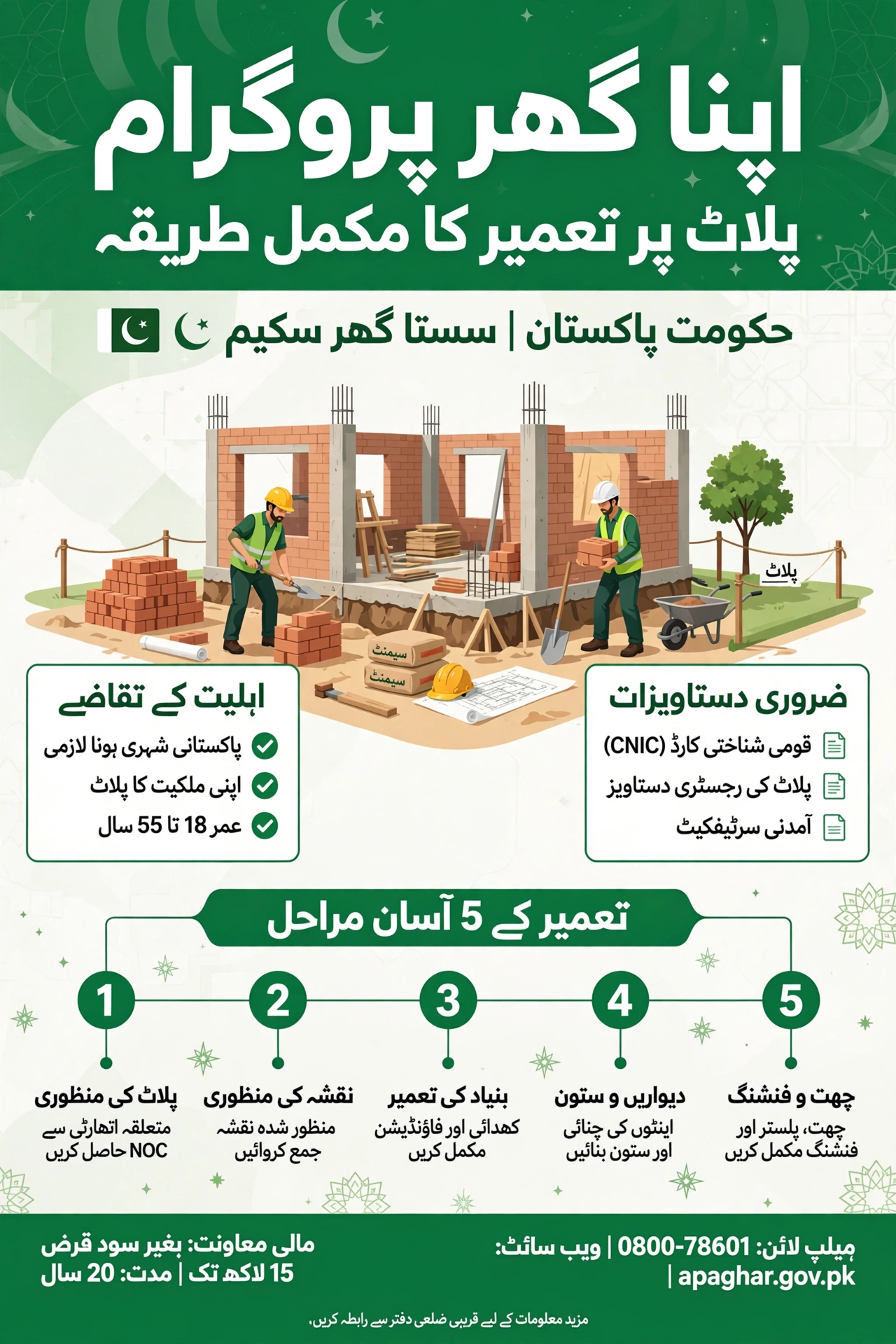
- Copy of valid CNIC (applicant and co-applicant, if any)
- Plot ownership proof — registry, fard-e-malkiat, or intiqal
- Approved construction map (naksha) from the development authority
- Site plan of the plot
- Income proof — salary slips or business income evidence
- Bank statements (usually the last 6 months)
- Recent passport-size photographs
- NOC from the housing society or authority (if applicable)
See our documents verification guide to avoid the most common paperwork mistakes.
Loan Disbursement in Construction Stages
Unlike a house purchase loan, construction financing is not paid out at once. The bank releases it in stages:
| Stage | Construction Milestone | Disbursement |
|---|---|---|
| 1 | Foundation and plinth completion | First installment |
| 2 | Grey structure — walls, roof, and pillars | Second installment |
| 3 | Finishing — plaster, flooring, fixtures, and paint | Final installment |
Before each installment, the bank’s evaluator inspects the site to confirm the claimed progress. Keep photographic records and contractor receipts for every stage.
Loan Amount, Markup and Repayment Terms
| Feature | Detail |
|---|---|
| Maximum loan | Up to Rs. 10 million (based on construction cost and repayment capacity) |
| Markup rate | Fixed subsidized 5% per annum for the first 10 years; then 1-year KIBOR + 3% |
| Loan tenure | Up to 20 years |
| Financing ratio | Bank finances up to 90% of the construction cost |
| Processing fee | Zero processing fees and no prepayment penalty |
Common Mistakes That Delay Approval
- Applying with an unclear or disputed plot title — get the fard verified first.
- Submitting an unapproved construction map.
- Name or address mismatch between your CNIC and the plot documents.
- Starting construction before loan approval — banks finance planned construction, not reimbursement of work already done.
- Incomplete income proof or a weak bank statement.
Many of these issues are also covered in our rejection reasons guide — read it before you apply.
FAQs – Apna Ghar Program Plot Construction
Can I apply if the plot is in my spouse’s or parent’s name?
Yes, in most cases a spouse can be added as a co-applicant, and banks accept plots owned by the applicant or co-applicant. A plot solely in a parent’s name usually requires a transfer or a co-applicant arrangement — confirm the exact rule with your chosen bank.
What is the maximum loan for plot construction?
Up to Rs. 10 million, depending on the verified construction cost and your repayment capacity. The bank finances up to 90% of the cost.
Is the plot construction loan interest-free?
It is subsidized, not interest-free: a fixed 5% per annum markup applies for the first 10 years, switching to 1-year KIBOR + 3% afterwards.
How is the loan amount disbursed?
In stages tied to construction milestones — foundation, grey structure, and finishing — with a bank inspection before each installment.
Can I construct in a private housing society?
Yes, provided the society is approved and recognized, and the plot has clear, verifiable ownership documents. An NOC from the society may be required.
How long does approval take?
Timelines vary by bank, but complete applications with verified plot documents are typically processed within a few weeks. Track your status with our tracking guide.
What happens if construction stops midway?
Inform your bank immediately. Further disbursements are paused until work resumes, and a prolonged stoppage can affect your loan terms — so finalize your contractor and budget before starting.
Final Thoughts
Apna Ghar Program plot construction is the most affordable route to homeownership if you already own land: subsidized markup, up to 20-year tenure, and stage-wise disbursement that keeps construction on track. The keys to fast approval are a dispute-free plot title, an approved construction map, and complete documents. Start with the online registration, and also read our house construction guide for practical building tips.