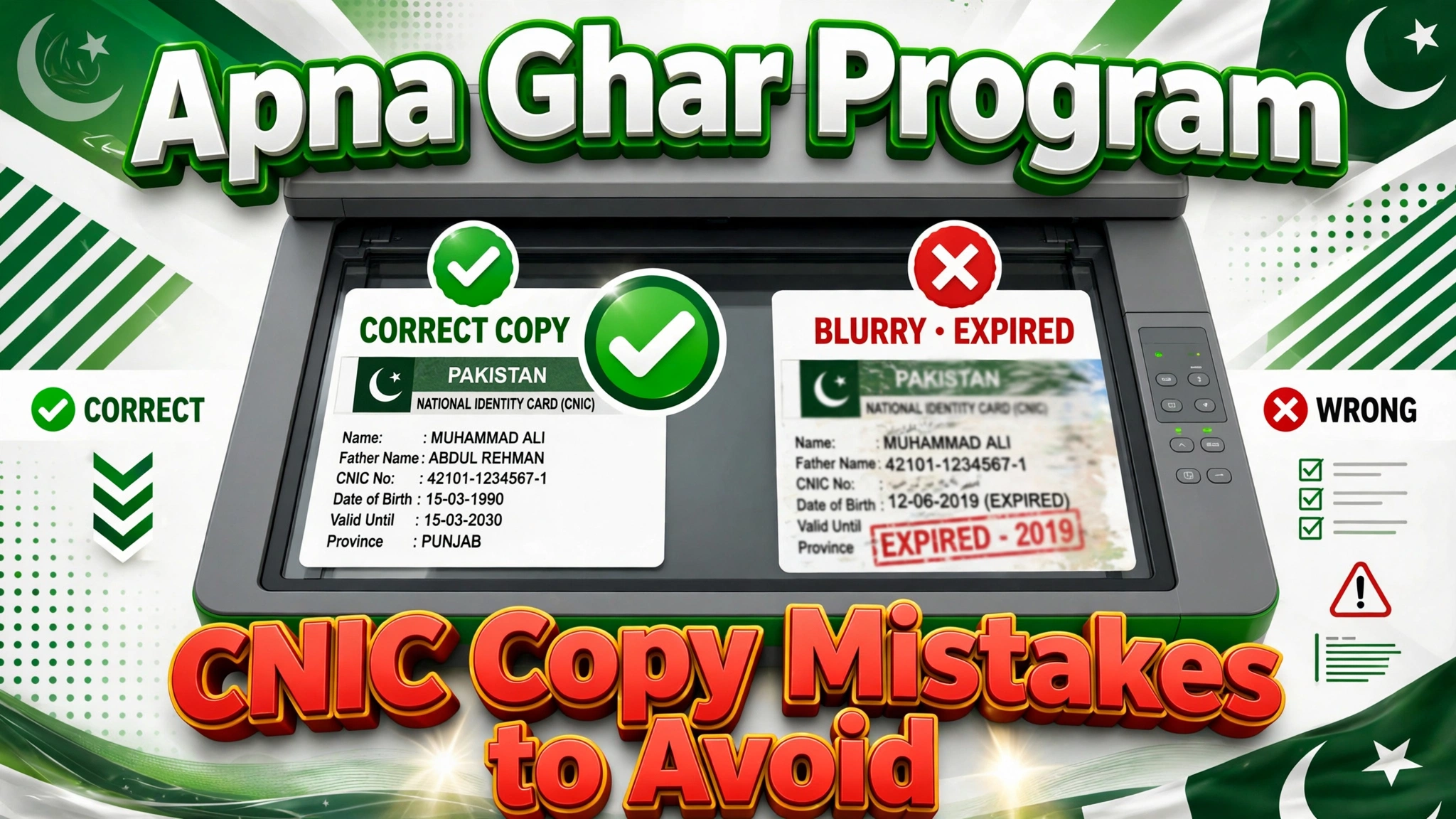
Your CNIC copy is the first document any verification officer looks at — and surprisingly, it is also one of the most common reasons applications get delayed. Knowing the Apna Ghar Program CNIC copy requirements and the mistakes to avoid can save you from a returned application. In this guide, we explain exactly what makes a CNIC copy acceptable, the common mistakes applicants make, how to prepare a perfect copy, the rules for co-applicants and family members, and answers to frequently asked questions.
Why Your CNIC Copy Matters So Much
Every other document in your application — your bank statement, income proof, property papers — is cross-checked against your CNIC. The bank verifies your identity with NADRA using the CNIC number on your copy, and your name spelling, father’s name, and address on the application form must all match the CNIC record. A poor-quality or expired CNIC copy stalls the very first verification step, as explained in our documents verification guide.
CNIC Copy Requirements for Apna Ghar Program
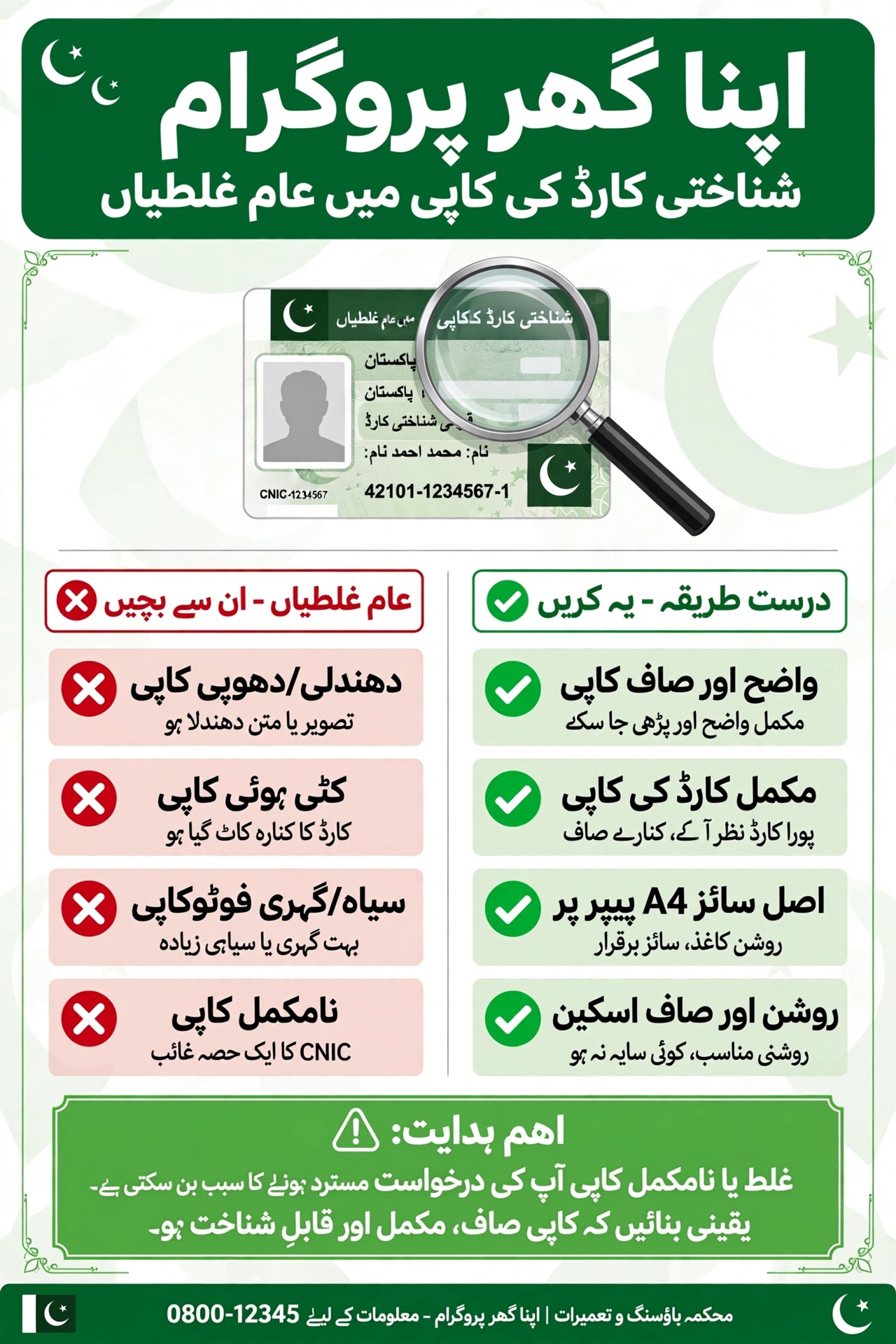
- Valid, unexpired CNIC: the card must be current — an expired CNIC is an instant rejection at verification.
- Front and back copies: both sides must be submitted; the back contains the family and address details banks check.
- Clear and legible: photo, name, CNIC number, and expiry date must all be easily readable.
- Full card visible: no cropped edges — the entire card including borders must appear in the copy.
- Actual size on A4: print or scan at real size on clean white paper; oversized or shrunken copies look unprofessional and can be rejected.
- Matches NADRA record: the details on the copy must match NADRA’s database exactly — spelling, numbers, everything.
- Applicant’s own CNIC: the copy must belong to the person named as the applicant on the form.
Common CNIC Copy Mistakes to Avoid
1. Submitting an Expired CNIC
The single most common mistake. Check the expiry date on your card today — if it has expired, renew it at NADRA before applying. Banks verify validity electronically.
2. Blurry or Dark Photocopies
Copies where the photo or text is unreadable are returned immediately. Use a proper scanner or a well-lit phone photo, never a copy-of-a-copy.
3. Cropped or Cut-Off Edges
If any edge of the card is cut off in the copy, verification officers cannot confirm the document is complete. Keep the whole card inside the frame.
4. Only the Front Side Submitted
Many applicants forget the back side. Both sides are required — the back carries address and family information the bank checks.
5. Name Spelling Mismatch
If your name on the application form, bank statement, or property documents is spelled differently than on the CNIC, verification fails. Standardize one spelling everywhere — the CNIC spelling wins.
6. Using Someone Else’s CNIC
Submitting a parent’s or spouse’s CNIC as your own identity proof (instead of adding them properly as a co-applicant) causes immediate rejection.
7. Old Photographs or Damaged Cards
A physically damaged card that is hard to read should be replaced with a reprint from NADRA before you apply.
How to Make a Perfect CNIC Copy
- Place your valid CNIC on a flatbed scanner (or a clean, well-lit surface for a phone scan).
- Scan both front and back at 300 DPI or higher.
- Check that every word, number, and the photo are sharp and readable.
- Print at actual size on A4 white paper if a hard copy is needed.
- Compare the copy against the original — nothing cropped, nothing blurry.
- Keep 4–5 extra copies; banks and offices ask for them at multiple stages.
CNIC Requirements for Co-Applicants and Family Members
- Co-applicant (e.g., spouse): must provide their own valid CNIC copy meeting the same quality standards.
- Overseas Pakistanis: a valid NICOP or POC is accepted in place of a CNIC — see our overseas Pakistanis guide.
- Family registration: some banks ask for the Family Registration Certificate (FRC) to confirm relationships — keep it ready.
FAQs – Apna Ghar Program CNIC Copy Requirements
Can I apply with an expired CNIC?
No. The CNIC must be valid at the time of application — NADRA verification will flag an expired card and your application will be returned.
Is a black-and-white photocopy acceptable?
A clean black-and-white copy is usually acceptable if fully legible, but a color scan is safer and looks more professional.
Do I need to attest the CNIC copy?
Requirements vary by bank — some accept plain copies since they verify electronically with NADRA, others ask for attestation. Confirm with your chosen bank.
What if my CNIC address is old?
An outdated address alone rarely blocks the application, but update it at NADRA when you can — consistency across documents speeds up verification.
Can I use my NICOP instead of CNIC?
Yes, overseas Pakistanis can use a valid NICOP or POC in place of a CNIC.
How many CNIC copies should I prepare?
At least 4–5 clear copies of both sides — you will need them at the portal upload, bank verification, and property transfer stages.
What happens if my name spelling differs across documents?
Verification fails. Fix the spelling to match your CNIC everywhere — on the form, bank statement, and property papers — before submitting.
Final Thoughts
The Apna Ghar Program CNIC copy requirements are simple but strict: a valid card, both sides, fully legible, matching NADRA records. It takes ten minutes to get right and can save you weeks of back-and-forth. Check your card’s expiry date today, make clean copies, and your application’s first verification step will pass without a hitch.