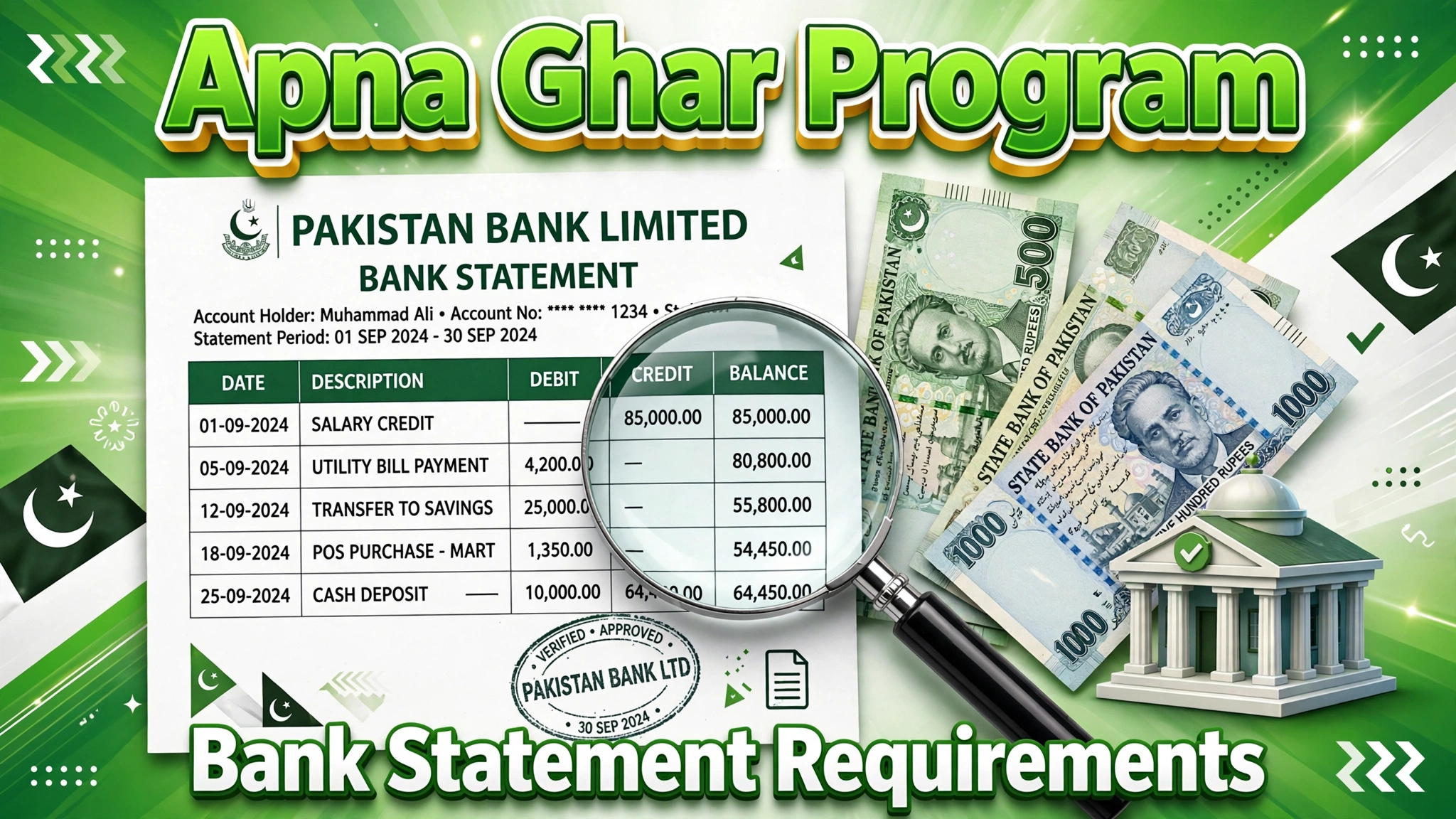
Your bank statement is one of the most closely examined documents in your Apna Ghar Program application. Understanding the Apna Ghar Program bank statement requirements before you apply can save you from weeks of delays or outright rejection. Banks use your statement to verify your income, check your spending habits, and judge whether you can reliably pay monthly installments for up to 20 years. In this complete guide, we explain exactly what banks require, what they look for in your statement, the most common mistakes applicants make, and how to prepare a statement that strengthens your case.
Why Banks Ask for Your Bank Statement
A bank statement is proof of your financial behavior. Salary slips show what you claim to earn; the statement shows what actually enters and leaves your account. Under the Wazir-e-Azam Apna Ghar Program 2026, participating banks are required to assess repayment capacity, and the statement is their primary tool for doing so. A clean, consistent statement builds trust — an irregular one raises questions that slow down your Apna Ghar Program loan approval.
Bank Statement Requirements for Apna Ghar Program
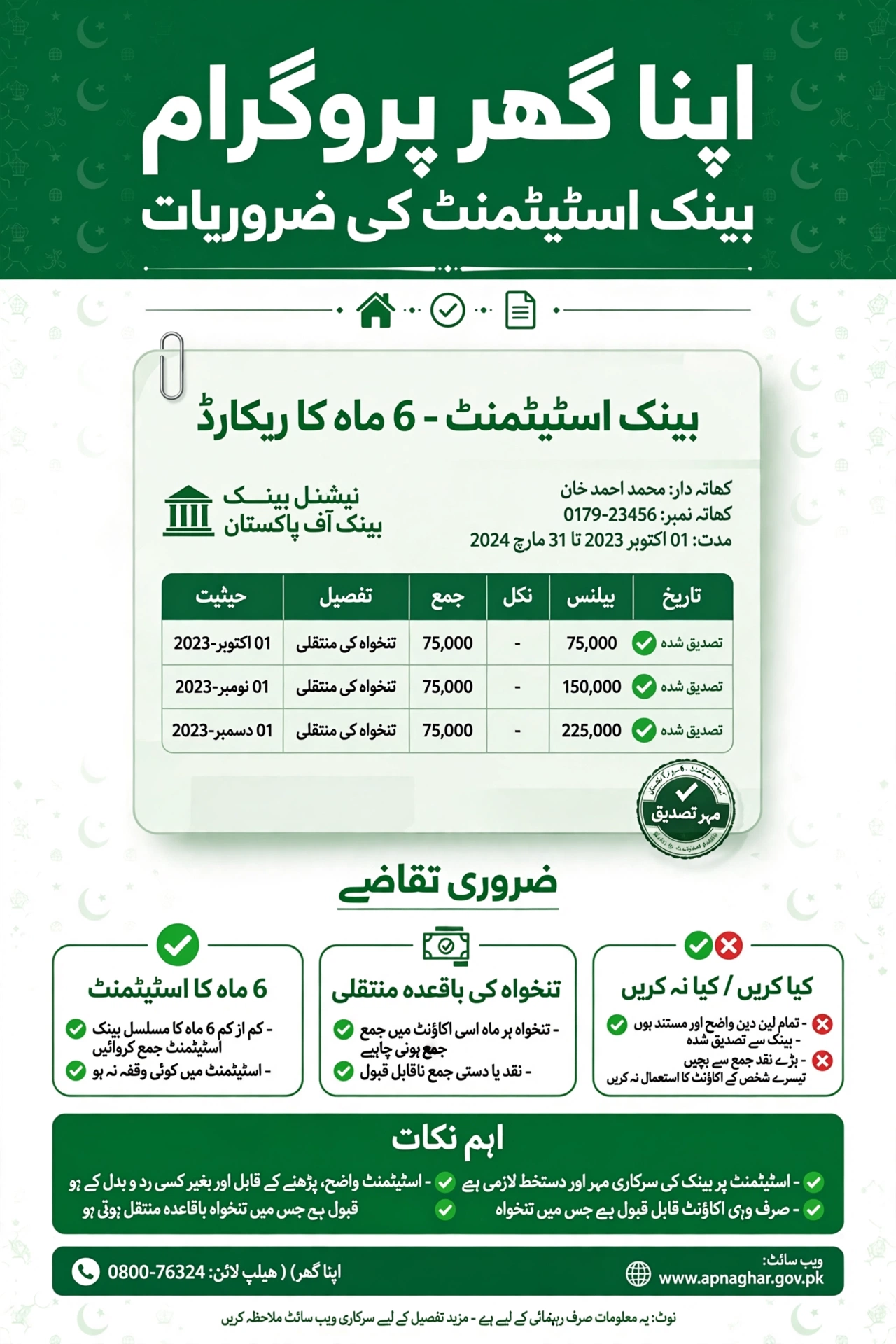
- Last 6 months: banks generally require a continuous 6-month statement with no missing months.
- Salary credits visible: your monthly salary must appear as a regular credit, ideally labeled as a salary transfer from your employer.
- Account in your name: the statement must belong to the applicant (or co-applicant) — a parent’s or friend’s account is not acceptable.
- Bank-stamped and signed: a statement printed from the branch with the bank’s stamp and an officer’s signature, or an officially generated e-statement.
- No unexplained gaps: long periods with zero activity look suspicious and invite extra scrutiny.
- Consistent with declared income: the credits in your statement must broadly match the income figure on your application form.
What Banks Check in Your Statement
| What They Check | What They Want to See |
|---|---|
| Regular income credits | Salary arriving every month, on roughly the same date |
| Average balance | A healthy balance that shows you manage money responsibly |
| Existing loan deductions | Any EMIs or markups already being paid (affects affordability) |
| Large unexplained deposits | Big cash deposits without a source raise red flags |
| Bounced cheques / failed transactions | Frequent failures suggest financial instability |
| Gambling or speculative transfers | Such entries can damage your credibility with the bank |
Requirements for Salaried vs Self-Employed Applicants
Salaried Applicants
Your case is simpler: the bank mainly wants to see salary credits from a verifiable employer matching your salary slips. Keep the same account active that your employer uses for payroll — switching accounts mid-application creates confusion.
Self-Employed and Business Applicants
Banks look for regular business income flowing through the account over at least 3 years. Because business income fluctuates, maintain clear records: business receipts, tax filings, and consistent deposits all help. A co-applicant with salaried income can strengthen a self-employed application. Check the general rules in our eligibility guide.
Common Bank Statement Mistakes That Get Applications Rejected
- Submitting a statement with missing months or unexplained gaps.
- Salary credited in cash or into a different account than the one submitted.
- Large, unexplained cash deposits just before applying (banks suspect borrowed funds).
- Heavy gambling, betting, or speculative trading transactions.
- Multiple bounced cheques or failed auto-debits.
- Submitting an unstamped printout or an edited PDF instead of an official statement.
- Statement name not matching the CNIC and application form exactly.
Many of these issues overlap with the problems covered in our rejection reasons guide.
How to Prepare a Strong Bank Statement
- Start early: at least 6 months before applying, route your salary through one account consistently.
- Keep it clean: avoid large unexplained cash deposits and keep gambling-type transactions out entirely.
- Maintain a buffer: an average balance covering 2–3 monthly installments signals reliability.
- Get it stamped: visit your branch for a stamped, signed statement — don’t rely on screenshots.
- Match your form: make sure the income and personal details on the statement match your application form exactly.
FAQs – Apna Ghar Program Bank Statement Requirements
How many months of bank statement are required?
Generally the last 6 months, continuous, with no gaps. Some banks may ask for more for self-employed applicants.
Can I submit a statement from a digital/mobile account?
Yes, as long as it is an officially generated statement from a recognized bank, showing your name, account number, and transaction history clearly.
Does the bank check my statement if I am salaried with salary slips?
Yes — salary slips and the statement are cross-checked against each other. Both must tell the same story.
What if my salary is paid in cash?
Cash salaries are hard to verify. Ask your employer to transfer salary to your bank account for at least 6 months before applying, and keep the slips.
Can I use my spouse’s bank statement?
Only if your spouse is a co-applicant on the loan. Otherwise, the statement must be in the applicant’s own name.
Will existing loans in my statement cause rejection?
Not automatically — but existing EMIs reduce your calculated affordability, which can lower the approved loan amount.
Should the statement be attested?
A branch stamp and officer’s signature (or an official e-statement) is the standard requirement. Confirm the exact format with your chosen bank from the banks list.
Final Thoughts
Meeting the Apna Ghar Program bank statement requirements is mostly about preparation: six clean months, visible salary credits, no gaps, and an official stamped copy. Treat your bank statement as your financial CV — banks read it carefully before trusting you with up to 20 years of financing. Get it right, and your application moves through verification without a hitch.