You submitted your application, and now the portal shows “Pending” — days pass, and nothing changes. What does Apna Ghar Program application pending actually mean, and should you be worried? In this guide, we explain what the pending status means, why applications stay pending, how long it should take (including the new 15-working-day rule), what to do while you wait, when pending becomes a problem, and answers to frequently asked questions.
What Does “Application Pending” Mean?
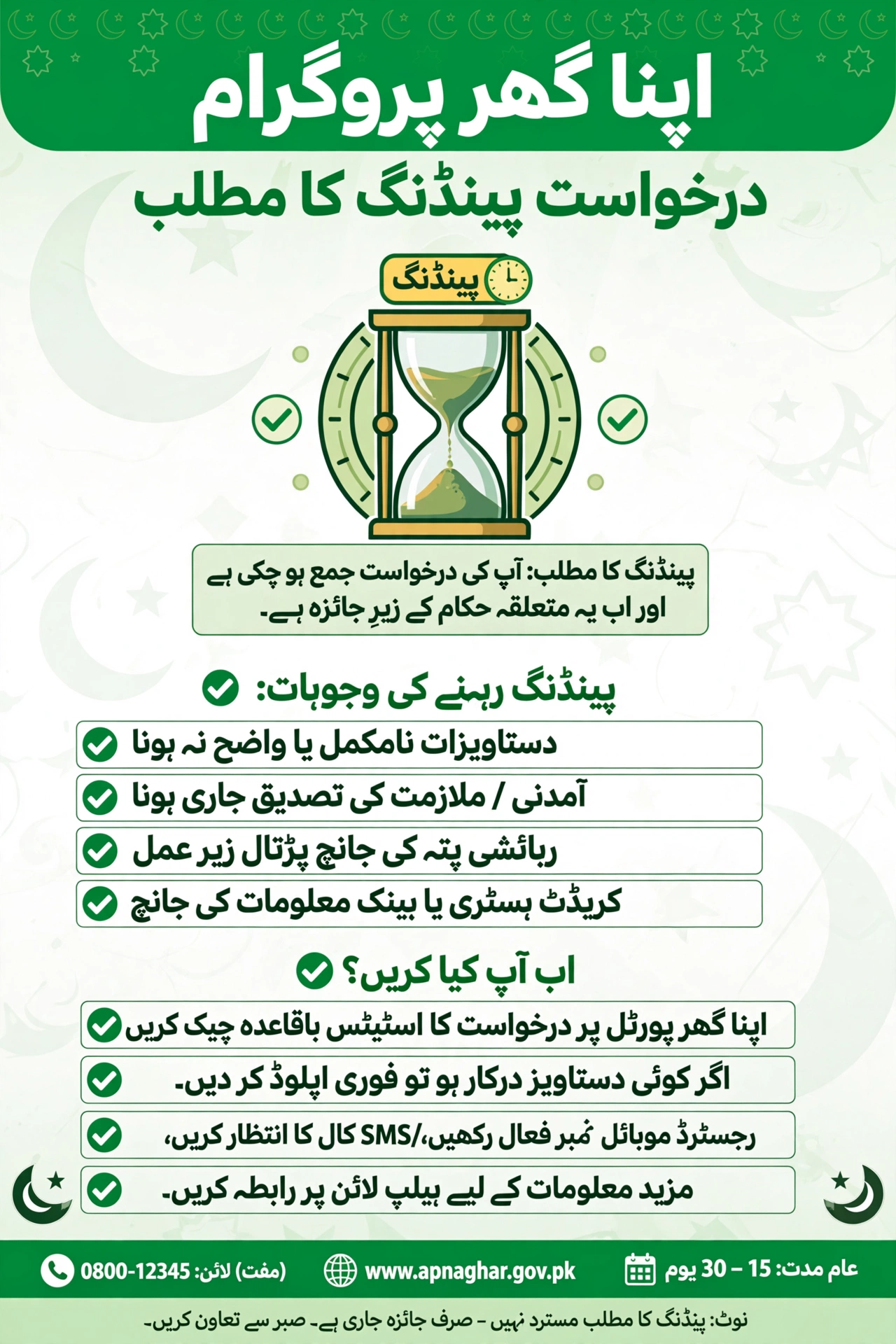
“Pending” simply means your application has been received and is waiting in the review queue — it has not been approved or rejected yet. Your documents are with the bank’s verification team, which checks them one stage at a time. Pending is a normal, neutral status — not a bad sign. Learn how to track your application status online.
Why Is My Application Still Pending?
Document Verification in Progress
Your CNIC, income proof, and bank statements are being checked for authenticity — this is the most common reason for a pending status.
Income or Employment Verification
The bank may contact your employer or verify your business income, which takes a few days. See income proof documents.
Property Verification Underway
If you applied for a house or flat, property verification (title check, valuation, inspection) runs in parallel and adds time.
High Application Volume
With over 75,000 approvals so far, banks process thousands of cases — queues grow after major announcements.
How Long Should “Pending” Take?
October 2026 update: the Prime Minister has directed that applications be processed within a maximum of 15 working days. Typical timelines:
| Stage | Typical Time |
|---|---|
| Initial document check | 3–5 working days |
| Income/employment verification | 5–7 working days |
| Property verification | 7–15 working days |
| Final decision | Within 15 working days total |
What to Do While Your Application Is Pending
- Check status regularly: log in to the portal every few days — don’t wait for an SMS that might not come.
- Keep your phone active: the bank may call for verification; answer unknown numbers during this period.
- Don’t submit duplicate applications: a second application can confuse the system and delay both.
- Prepare for “Documents Required”: keep extra copies of all documents ready in case the bank asks.
- Don’t change your property: switching the house or flat mid-process restarts verification.
When “Pending” Becomes a Problem
- Beyond 15 working days with no update — contact your bank branch or the helpline.
- Status stuck on “Documents Required” — upload the requested documents immediately; the clock pauses until you do.
- No SMS or call for weeks — your registered mobile number may be inactive; verify it.
FAQs – Apna Ghar Program Application Pending
Is “pending” a bad sign?
No — pending is neutral. It means your application is in the queue awaiting review, not that anything is wrong.
How long does the pending stage last?
Typically 1–3 weeks; the October 2026 directive caps processing at 15 working days.
Why has my application been pending for a month?
Likely causes: missing documents, unverifiable income, property issues, or high volume. Check your status for a “Documents Required” notice.
Can I speed up a pending application?
You can’t skip the queue, but complete documents and quick responses to bank queries prevent delays.
Does pending mean I need to visit the bank?
Not necessarily — most verification happens without a visit. The bank will call you if one is needed.
Will I get an SMS when the status changes?
Usually yes, but don’t rely on it — check the portal yourself regularly.
What comes after pending?
Your status moves to Approved, “Documents Required”, or Rejected — see what each means.
Final Thoughts
Apna Ghar Program application pending means one thing: wait, but wait smartly. Track your status, keep your phone on, respond fast to document requests — and with the new 15-working-day rule, you shouldn’t be waiting in the dark for long.