
Apna Ghar Program Banks in Pakistan
Apna Ghar Program Banks. If you want to know which banks are providing housing finance under the Prime Minister’s Apna Ghar program, you are not alone. Due to various websites, old blog posts and scattered information, it is often difficult to reach the correct list. That is why we have compiled the latest information on the banks involved in the program in one place in this guide. Here you will be able to know which banks provide loans under the scheme, what are the basic facilities of each bank, and which bank you can choose according to your financial needs and eligibility.
What Is the Wazir-e-Azam Apna Ghar Program?
Also known by its everyday name, “Ghar Ho Tu Apna,” this is a federal housing finance scheme launched under the government of Pakistan, regulated by the State Bank of Pakistan (SBP). The idea behind it is fairly simple: property prices and standard bank markup rates have priced most middle- and lower-income families out of homeownership, so the government steps in with a subsidy on the profit rate. That subsidy is what allows the customer to pay a fixed markup, typically around 5%, while the bank still earns a market-based return covered partly by the government.
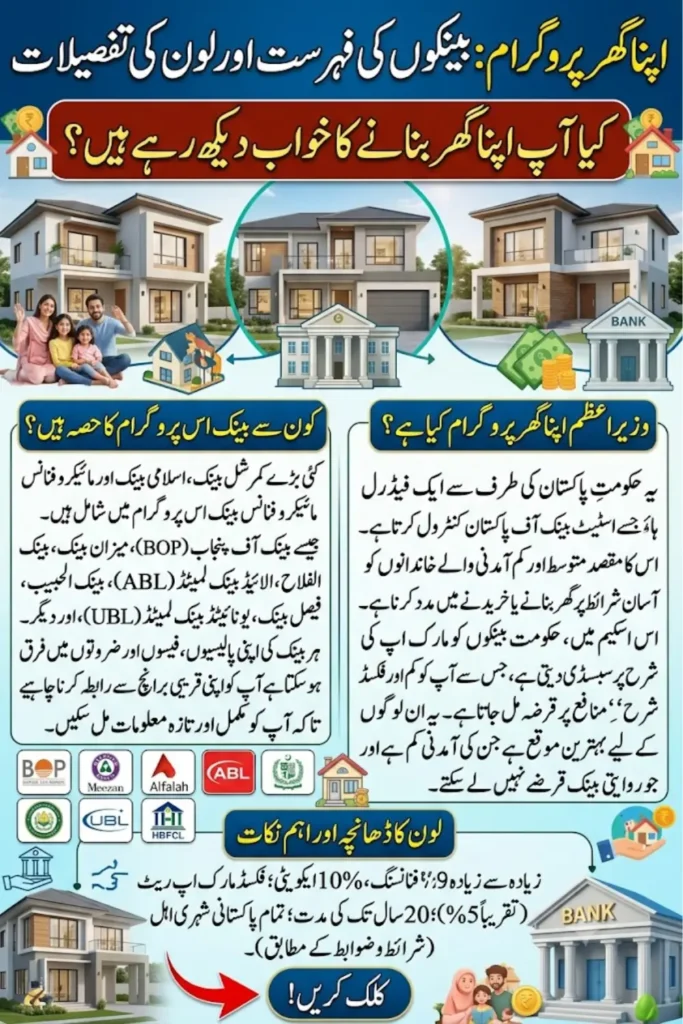
The biggest advantage of this program is that now even people who previously found it difficult to get a traditional bank loan can get housing finance on easy terms. This includes salaried employees, self-employed individuals, and citizens running small businesses. If you want to buy a ready-made house or need financial assistance to build a new house on your own land, the Prime Minister’s Apna Ghar program provides you with a better and more viable opportunity to fulfill your dream of a house.
Which Banks Are Part of the Apna Ghar Program?
Under the Prime Minister’s Apna Ghar Program, several commercial banks, Islamic banks and microfinance banks along with House Building Finance Company Limited (HBFCL) are providing housing finance facilities. HBFCL is an experienced institution in the housing finance sector in Pakistan and has been providing financial assistance for homes for many years. However, it is not necessary that every branch of every bank processes loans under this program. Therefore, it is better to contact your nearest branch and confirm before submitting an application or preparing documents, so that you can get accurate information and timely guidance.
Commercial and Islamic Banks
| Bank | Financing Type |
| The Bank of Punjab (BOP) | Conventional |
| Meezan Bank | Islamic (Diminishing Musharakah) |
| Bank Alfalah | Conventional & Islamic |
| Allied Bank Limited (ABL) | Conventional |
| Bank AL Habib | Conventional |
| Faysal Bank | Islamic |
| United Bank Limited (UBL) | Conventional |
| MCB Islamic Bank | Islamic |
| BankIslami | Islamic |
| Askari Bank | Islamic (Diminishing Musharakah) |
Microfinance Banks
| Bank |
| ASA Pakistan Microfinance Bank |
| HBL Microfinance Bank |
| Khushhali Microfinance Bank |
| Mobilink Microfinance Bank |
| LOLC Microfinance Bank |
| U Microfinance Bank |
If you are applying for housing finance for the first time, have a limited credit history, or your income comes from a business or freelance work rather than a regular salary, microfinance banks may be a better choice for you. These banks provide loans specifically tailored to the financial circumstances of small business owners, home business owners, freelancers, and other self-employed individuals, which can increase your chances of getting housing finance.
House Building Finance Company Limited (HBFCL)
HBFCL deserves a separate mention because it’s Pakistan’s oldest dedicated housing finance institution, and it participated in both the earlier Mera Pakistan Mera Ghar scheme and the current Apna Ghar Program. If your priority is a lender that specializes exclusively in housing rather than treating it as one product among many, HBFCL is worth a look.
Loan Structure: What You’re Actually Getting
Across most participating banks, the program follows a broadly similar structure:
- Financing model: A 90:10 arrangement, where the bank finances up to 90% of the property value and you contribute the remaining 10% as equity.
- Markup rate: A fixed rate around 5% for the customer, with the government subsidizing the difference to the bank’s actual cost of funds.
- Loan tenure: Repayment periods extending up to 20 years, which keeps monthly installments manageable even on a modest salary.
- Loan amount: Financing limits vary by bank and by category (house purchase, construction, or renovation), so it’s worth asking your shortlisted bank for their current ceiling rather than relying on a single number.
Although the basic principles and eligibility conditions of the Prime Minister Apna Ghar program are set by the government, they are implemented by each bank as per its internal procedures. Therefore, processing fees, required documents, insurance conditions, application verification procedures and other administrative requirements may vary from one bank to another. It is better to get the latest information from the concerned bank before applying so that there is no hassle or delay later.
Islamic vs. Conventional: Which Should You Choose?
If you want to avoid interest-based housing finance for religious reasons, several Islamic banks offer Sharia-compliant financing under the Prime Minister Apna Ghar program. These include Meezan Bank, Faisal Bank, MCB Islamic Bank, Bank Islami, and Askari Bank. In this Islamic financing model, the bank and the consumer become partners in the property under a contract, while the consumer gradually buys out the bank’s share through fixed installment payments. This mechanism is designed in accordance with Sharia principles to provide an alternative and Islamic way of acquiring a home. Conventional banks like BOP, ABL, Bank AL Habib, and UBL follow a standard markup-based loan structure instead. Functionally, both routes get you to homeownership; the difference is mostly in the underlying contract and, for many applicants, peace of mind.
How to Apply
- Check your eligibility. You generally need to be a Pakistani citizen (resident or non-resident, depending on the bank), a first-time homeowner, and able to show a steady income source.
- Pick your bank. Base this on whether you want Islamic or conventional financing, whether you’re closer to a microfinance bank’s typical customer profile, and which bank has a branch actually processing Apna Ghar applications near you.
- Gather your documents. CNIC, income proof (salary slips or business income evidence), bank statements, and property documents if you already own land.
- Apply at the branch or online. Some banks allow you to start through the official Apna Ghar portal, while others still require an in-person branch visit for the formal application.
- Wait for verification. The bank and, in many cases, SBP will verify your documentation before disbursing funds.
For the most current guidelines, application forms, and any policy updates, it’s worth checking the official Apna Ghar portal directly, since individual bank pages don’t always reflect the latest federal rules.
Final Thoughts
The list of Apna Ghar Program banks in Pakistan is wider than most people realize, spanning major commercial names, dedicated Islamic banks, several microfinance institutions, and HBFCL. The right choice really comes down to two questions: do you want Islamic or conventional financing, and does your income profile fit a commercial bank’s typical applicant or a microfinance bank’s? Once you’ve answered those, narrowing down to a specific branch and starting your application becomes a much simpler process.
Wazir-e-Azam Apna Ghar Program Loan – Features and Requirements